
BLOG
The Concrete Leak That Cost $140,000—And the Engineering Shift That Followed

For decades, reinforced concrete was the default choice for large-scale industrial liquid storage. It felt permanent, heavy, and indestructible. However, plant engineers are increasingly uncovering a structural reality: concrete possesses inherent, microscopic flaws that physics and chemistry eventually expose.
Today, modern manufacturing and processing facilities are rapidly transitioning to Glass Reinforced Plastic (GRP) and Fiber Reinforced Plastic (FRP) solutions. Engineered by specialized manufacturers like GRP Engineers, these advanced composite systems offer distinct operational, structural, and financial advantages over traditional civil concrete.
The Turning Point: An Engineering Reality Check
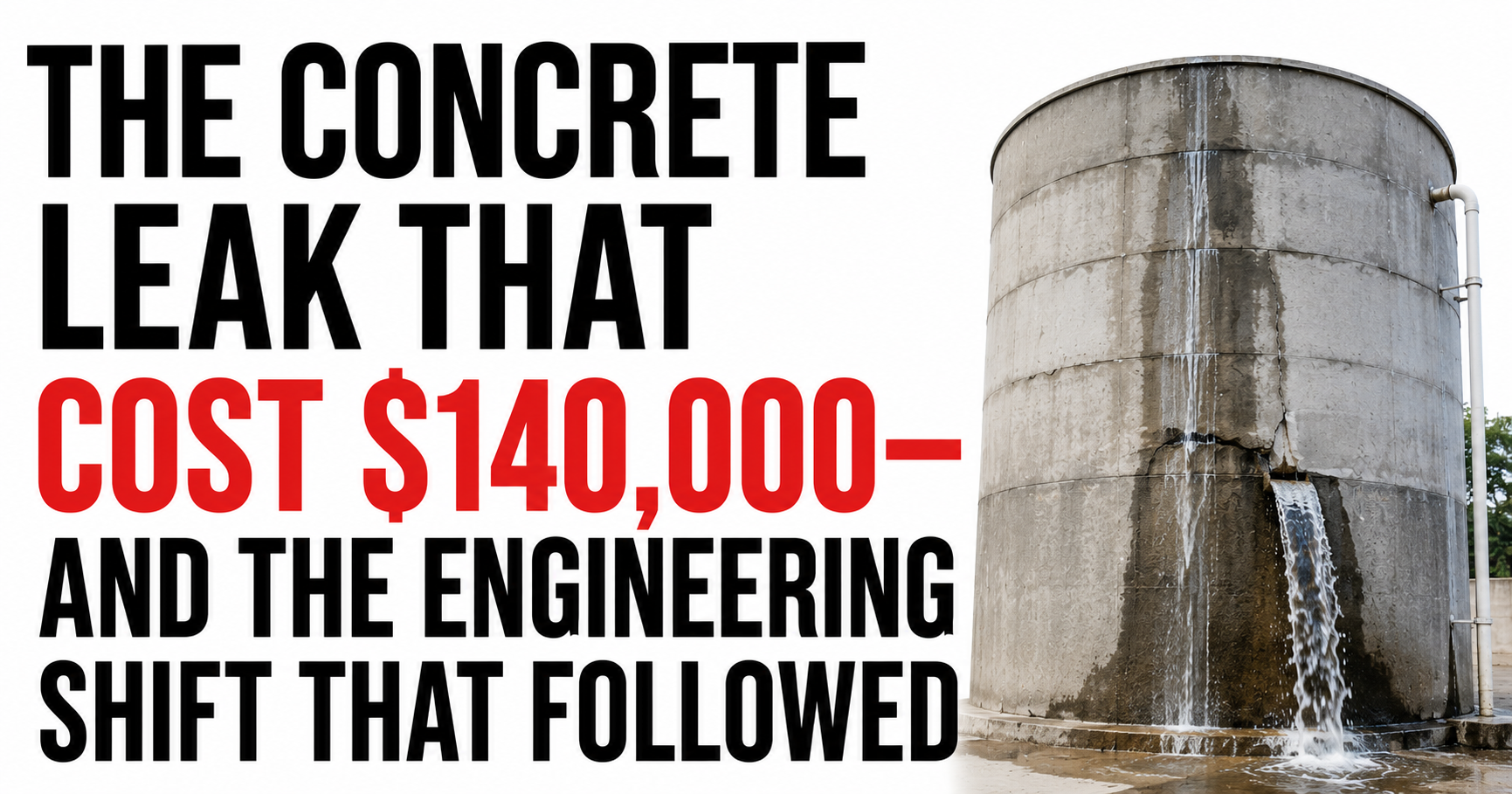
To understand why this material shift is happening globally, consider a scenario faced by Chief Plant Engineer Marcus Vance at a major chemical processing facility. Marcus stood at the base of his facility's primary 100,000-gallon concrete process water reservoir, watching a damp, dark discoloration creep across the exterior wall.
It wasn’t just water weeping through the structure—it was a sign of systemic infrastructure failure. Over seven years of continuous operation, microscopic chemical compounds in the treated water had migrated through the concrete’s porous walls. The liquid eventually reached the internal steel rebar, triggering a destructive chemical process called carbonation. As the steel rusted, it expanded, cracking the concrete from the inside out.
The resulting emergency shutdown, structural patch-work, and costly epoxy re-lining cost the facility fourteen days of total production standstill and $140,000 in lost revenue. When the time came to replace the infrastructure, Marcus didn't order concrete mixers; he shifted the plant's strategy entirely to composite engineering.
Concrete Failure Loop:
Porosity ──> Moisture Ingress ──> Rebar Oxidation ──> Structural Micro-Cracking
GRP Security Loop:
UV-Resistant Resin ──> Zero Porosity ──> High Elasticity ──> Monolithic Containment
1. Structural Comparison: Material Physics of GRP vs. Concrete
When evaluating long-term infrastructure assets, the physical properties of the storage medium dictate its lifetime value. Concrete is highly capable under compression but inherently weak under tension. When subjected to shifting soils, thermal cycling, or sudden hydraulic surges, it develops micro-fractures.
GRP and FRP water tanks resolve this issue through engineered material elasticity. By combining high-tensile glass fibers with resilient polymer resins, fiberglass structures flex slightly under dynamic hydraulic loads without fracturing or losing structural integrity.
GRP/FRP water tanks offer an exceptional strength-to-weight ratio compared to concrete, eliminating the risk of micro-cracking, fluid leaching, and heavy foundation requirements. Unlike concrete, high-grade fiberglass does not require secondary chemical liners to safely isolate industrial-grade or potable fluids.
Engineering Material Metrics
|
Performance Feature |
GRP / FRP Tanks (GRP Engineers) |
Reinforced Concrete Tanks |
|---|---|---|
|
Average Lifespan |
30 to 50+ Years |
15 to 20 Years (Before Major Repair) |
|
Internal Surface Finish |
Smooth, High-Gloss Resin Liner |
Rough, Pitted, and Porous |
|
Weight Profile |
Lightweight (Low Structural Load) |
Extremely Heavy (High Dead Weight) |
|
Foundation Requirement |
Standard Concrete Flat Pad |
Deep-Pile Structural Foundations |
|
Risk of Leaking |
Monolithic / Engineered Seals |
High (Joints, Cracks, Porosity) |
|
Installation Schedule |
3 to 5 Days (Modular) |
28+ Days (Civil Curing Required) |
2. Defeating Chemical and Environmental Corrosion
The primary operational drawback of concrete in an industrial footprint is its vulnerability to chemical attack. Concrete is alkaline by nature; when it comes into contact with acidic process water, treated wastewater, or ambient industrial gasses, the matrix weakens.
FRP and GRP tanks are completely inert. Because they are manufactured using premium-grade resins and advanced fiberglass reinforcement layers, they are immune to electrochemical corrosion. They do not rust, scale, or pit. This makes them ideal for demanding applications, including:
- Aggressive industrial wastewater treatment chemicals and coagulants.
- High-salinity water or coastal environments prone to salt-air degradation.
- Demanding outdoor setups exposed to heavy ultraviolet (UV) radiation.
For facilities operating integrated thermal loops, this material stability is crucial. For instance, when routing process water through heavy industrial systems, utilizing clean containment prevents debris and scale from fouling down-line infrastructure like high-efficiency Fiberglass Cooling Tower Casings.
3. Geometric Engineering: Rib Reinforcements and Molded Bases
Concrete tanks rely strictly on raw mass and thick rebar grids to handle outward hydrostatic pressure. This massive weight forces companies to invest heavily in extensive soil testing, excavation, and deep-pile foundations just to hold the tank itself.
Modern fiberglass engineering replaces sheer mass with elegant geometric design. Premium industrial GRP systems utilize two specific structural enhancements to maximize safety while minimizing material weight:
- Integrated Structural Reinforcement Ribs: Molded directly into the exterior wall panels, these structural reinforcement ribs function as a high-tensile exoskeleton. They absorb the circumferential hoop stress generated by the liquid volume, preventing the tank walls from bulging or warping.
- Precision Molded Support Bases: Rather than resting flat on a rough concrete floor where small debris can create catastrophic pressure points, custom molded bases distribute the downward hydraulic force evenly across the foundation pad.
FRP and GRP tanks are completely inert. Because they are manufactured using premium-grade resins and advanced fiberglass reinforcement layers, they are immune to electrochemical corrosion. They do not rust, scale, or pit. This makes them ideal for demanding applications, including:
- Aggressive industrial wastewater treatment chemicals and coagulants.
- High-salinity water or coastal environments prone to salt-air degradation.
- Demanding outdoor setups exposed to heavy ultraviolet (UV) radiation.
For facilities operating integrated thermal loops, this material stability is crucial. For instance, when routing process water through heavy industrial systems, utilizing clean containment prevents debris and scale from fouling down-line infrastructure like high-efficiency Fiberglass Cooling Tower Casings.
4. Sanitation and Algae Control
For facilities managing potable water, pharmaceutical processes, or food and beverage manufacturing, fluid purity is non-negotiable. This is where concrete presents a silent biological hazard.
The rough, pitted texture of concrete provides a microscopic sanctuary where bacterial biofilm, mold, and algae can anchor and multiply. Furthermore, concrete absorbs and retains ambient atmospheric heat, warming the stored water and accelerating biological growth. Cleaning a fouled concrete tank requires intensive downtime, confined-space entry teams, high-pressure washing, and aggressive chemical washes that threaten to leach into the water system.
GRP water tanks completely eliminate this maintenance headache. The interior face of a premium fiberglass tank features an ultra-smooth, food-grade resin liner that gives biological matter nothing to stick to. Additionally, the specialized panel construction is formulated to be 100% opaque. By blocking out all natural sunlight, the photosynthesis process required for algae growth is entirely cut off.
FRP and GRP tanks are completely inert. Because they are manufactured using premium-grade resins and advanced fiberglass reinforcement layers, they are immune to electrochemical corrosion. They do not rust, scale, or pit. This makes them ideal for demanding applications, including:
- Aggressive industrial wastewater treatment chemicals and coagulants.
- High-salinity water or coastal environments prone to salt-air degradation.
- Demanding outdoor setups exposed to heavy ultraviolet (UV) radiation.
For facilities operating integrated thermal loops, this material stability is crucial. For instance, when routing process water through heavy industrial systems, utilizing clean containment prevents debris and scale from fouling down-line infrastructure like high-efficiency Fiberglass Cooling Tower Casings.
5. Total Cost of Ownership (TCO) and Lifecycle ROI
While the raw initial material cost of pouring concrete can sometimes appear competitive on a spreadsheet, analyzing the Total Cost of Ownership (TCO) reveals a major financial disparity.
Concrete Timeline: [Excavation] ──> [Rebar Grid] ──> [Pouring] ──> [28-Day Cure] ──> [Coating]
GRP Timeline: [Excavation] ──> [Pad Pour] ──> [Rapid Panel Assembly (3 Days)] ──> [Go Live]
- Elimination of Curing Downtime: Concrete requires on-site forming, pouring, and a standard 28-day curing cycle before it can even be hydro-tested. A modular GRP tank from GRP Engineers arrives as a precision-fit kit that can be assembled, sealed, and commissioned within a single week.
- Zero Routine Linings: Concrete tanks must be drained, inspected, and re-coated with expensive epoxy liners every 3 to 5 years to manage porosity. GRP tanks require virtually zero scheduled structural maintenance throughout their lifespan.
- Future Footprint Flexibility: A concrete tank is a permanent civil modification. A modular GRP panel tank can be unbolted, expanded to accommodate higher capacities, or completely relocated if your industrial facility undergoes a future physical expansion.
A Maintenance-Free Future
For modern industrial plants prioritizing maximum uptime, structural longevity, and strict fluid purity, concrete is rapidly becoming an outdated strategy. The transition to composite engineering ensures that vital utility and storage assets remain leak-free, clean, and operational for decades.