



BLOG
How Fiberglass Reaction Vessels Eliminated Exothermic Thermal Shock and Saved $165,000

Plant Operations Director Tariq Mirza stood on the catwalk overlooking Processing Line 2 as an acrid cloud of vapor escaped from a fractured glass-lined reaction vessel.
Within minutes, production had stopped.
A routine batch involving concentrated acid addition and rapid agitation had turned into an expensive equipment failure. The exothermic reaction caused the vessel temperature to rise from 25°C to 95°C in less than four minutes. While the carbon steel shell expanded rapidly under the sudden heat, the rigid glass lining couldn't expand at the same rate.
The result was catastrophic.
The glass liner cracked under thermal stress, creating microscopic pinholes that exposed the underlying steel to highly corrosive chemicals. Within a short time, pitting corrosion developed, pressure dropped, and the entire batch was lost.
The incident forced an emergency shutdown that ultimately cost the facility $165,000 in equipment replacement, production losses, cleanup, and disposal.
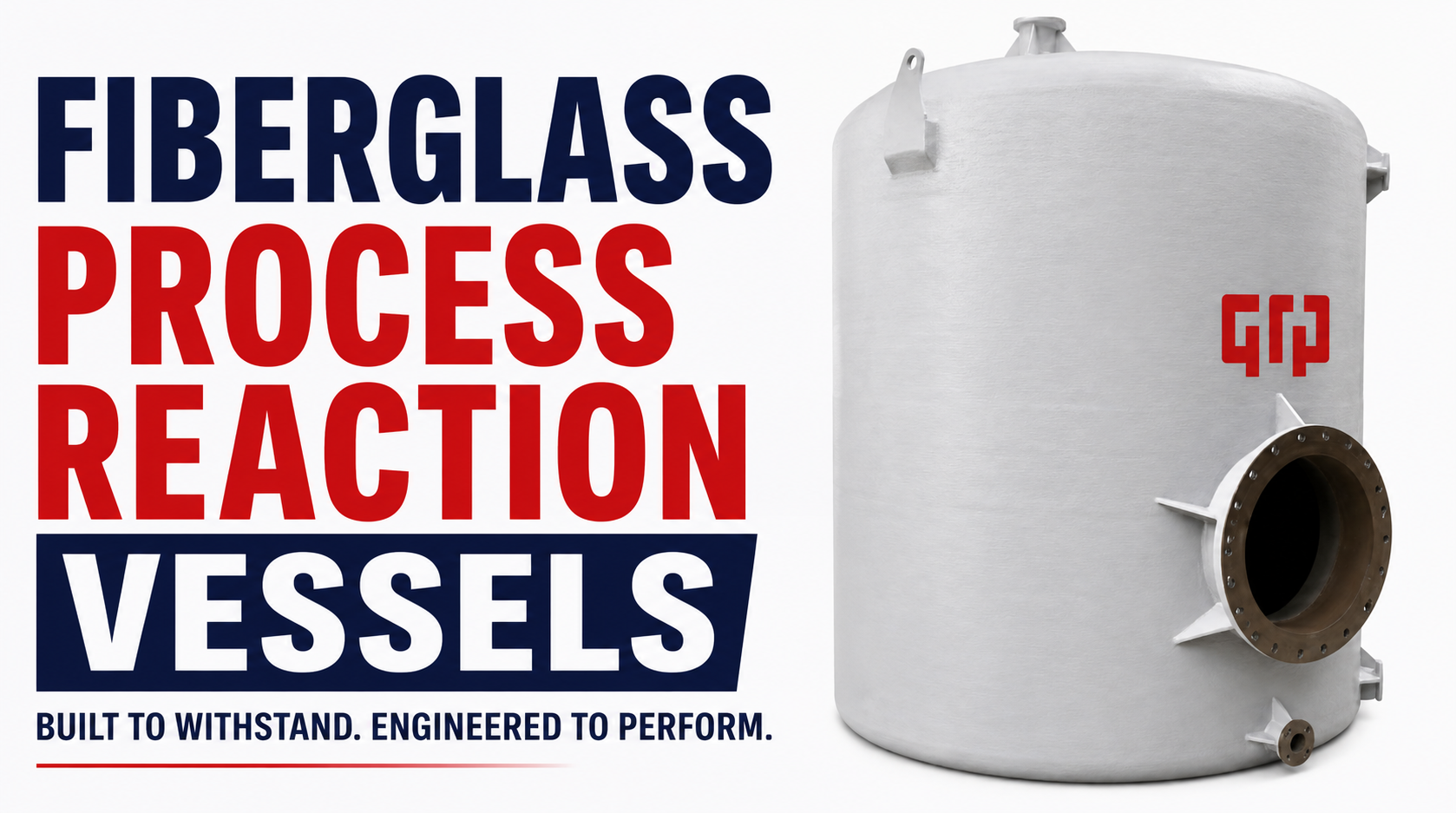
Rather than replacing the failed unit with another glass-lined or stainless-steel vessel, Tariq decided to rethink the entire system. After consulting GRP Engineers, the plant upgraded Processing Line 2 with custom-engineered Fiberglass Process Reaction Vessels, eliminating the root cause of thermal shock failures.
Why Glass-Lined Steel Fails During Exothermic Reactions
Glass-lined steel reactors have long been used in chemical processing because of their corrosion resistance. However, they possess a significant structural weakness during rapid temperature fluctuations.
During highly exothermic reactions:
Rapid Exothermic Spike → Thermal Expansion Mismatch → Glass Liner Cracking → Steel Corrosion → Equipment Failure
The steel shell expands quickly as temperatures rise, while the brittle glass lining remains comparatively rigid. This mismatch generates tremendous internal shear stress that eventually fractures the glass lining.
Once even tiny cracks appear, aggressive chemicals penetrate beneath the glass and attack the steel shell, accelerating corrosion and significantly reducing vessel life.
How Fiberglass Reaction Vessels Eliminate Thermal Shock
Unlike traditional glass-lined equipment, fiberglass reaction vessels are manufactured as a monolithic composite structure.
Using premium vinyl ester resin reinforced with continuous fiberglass, the corrosion barrier and structural shell behave as a single engineered system.
Instead of fighting against different expansion rates, the entire vessel expands uniformly during rapid temperature changes.
Composite GRP Reaction Loop
Monolithic Resin Matrix → Uniform Thermal Expansion → Impermeable Corrosion Barrier → Zero Thermal Shock Fatigue
Because the structure remains flexible at a microscopic level, it absorbs sudden thermal and pressure loads without:
- Glass cracking
- Liner separation
- Structural delamination
- Fluid seepage
The result is significantly greater reliability during aggressive exothermic processing.
Material Homogeneity Makes the Difference
The greatest advantage of fiberglass process reaction vessels lies in their homogeneous construction.
Unlike glass-lined steel, which combines two materials with very different mechanical properties, composite vessels function as a single engineered material.
When temperatures rapidly increase, the vessel wall expands evenly throughout its thickness, dramatically reducing internal stress concentrations.
This eliminates one of the primary causes of unexpected reactor failures in chemical processing plants.
Chemical Resistance Beyond Stainless Steel
Thermal performance alone wasn't enough for Tariq's facility.
The process also involved highly aggressive chemicals capable of attacking conventional metals.
Even premium alloys such as 316L stainless steel or Hastelloy may eventually experience:
- Localized pitting corrosion
- Crevice corrosion
- Stress corrosion cracking (SCC)
- Surface degradation under chloride-rich environments
Composite engineering offers a completely different approach.
Instead of depending on metallic corrosion resistance, fiberglass reaction vessels utilize carefully selected resin systems designed specifically for each chemical environment.
Premium Vinyl Ester Resin
High-performance vinyl ester resins provide exceptional resistance against:
- Strong acids
- Chlorides
- Organic solvents
- Continuous thermal cycling above 100°C
Synthetic Corrosion Veil
The interior corrosion barrier contains approximately 80% resin, forming an impermeable chemical shield that prevents chemicals from reaching the structural fiberglass layers.
This engineered barrier dramatically extends service life while minimizing maintenance requirements.
Performance Comparison
|
Engineering Metric |
Fiberglass Reaction Vessels |
Glass-Lined Steel |
Stainless Steel (316L) |
|---|---|---|---|
|
Thermal Shock Resistance |
Excellent |
Poor |
Moderate |
|
Chemical Corrosion Resistance |
Excellent |
Good (until liner damage) |
Moderate |
|
Maintenance |
Simple on-site composite repair |
Factory re-glassing required |
Specialized welding |
|
Weight |
Approximately 75% lighter |
Very heavy |
Heavy |
|
Typical Service Life |
25+ years |
5–7 years |
8–10 years |
Built for Heavy Agitators and Continuous Mixing
Industrial reactors experience constant mechanical loading from:
- High-torque agitators
- Mixing impellers
- Fluid turbulence
- Continuous vibration
Traditional welded metallic nozzles often develop fatigue cracks around these high-stress areas.
GRP Engineers reinforces every critical connection using additional fiberglass laminates and heavy-duty composite overlays around:
- Agitator mountings
- Manways
- Nozzles
- Structural penetrations
These reinforced zones distribute vibration evenly throughout the vessel wall, minimizing stress concentrations and extending operational life.
Seamless Integration with Plant Utility Systems
Reaction vessels rarely operate as standalone equipment.
Modern processing facilities integrate them into broader plant utility networks.
For example:
- Corrosive process vapors can be safely extracted through fiberglass blower systems.
- Cooling water circuits can connect directly to fiberglass cooling towers.
- Chemical discharge systems integrate with fiberglass storage tanks without introducing corrosion-prone metallic components.
Using corrosion-resistant composite equipment throughout the process creates a more reliable and lower-maintenance production environment.
Frequently Asked Questions
What operating temperatures can fiberglass reaction vessels handle?
Depending on the selected resin system and chemical service, fiberglass reaction vessels from GRP Engineers can typically operate continuously between -40°C and 105°C (220°F+).
Can fiberglass reaction vessels be repaired?
Yes.
Unlike glass-lined reactors that often require costly factory re-glassing, composite vessels can usually be repaired on-site using localized fiberglass reinforcement and resin restoration, significantly reducing downtime.
Can fiberglass vessels operate under vacuum?
Yes.
For vacuum service, vessels are engineered with thicker laminate construction and external stiffening rings to resist buckling under full vacuum conditions while complying with standards such as ASME RTP-1.
The Smarter Choice for Modern Chemical Processing
For facilities handling aggressive exothermic reactions, relying on brittle glass linings or expensive metallic alloys introduces unnecessary operational risk.
Fiberglass process reaction vessels offer a more resilient solution by combining:
- Excellent thermal shock resistance
- Outstanding corrosion protection
- Lightweight construction
- Simplified maintenance
- Long service life
- Lower lifecycle costs
After replacing the failed glass-lined reactor with a custom composite vessel from GRP Engineers, Tariq's facility eliminated recurring thermal shock failures and significantly improved production reliability.
If your operation demands dependable performance under aggressive chemical conditions, explore GRP Engineers' Fiberglass Process Reaction Vessels to learn how a custom-engineered composite solution can improve safety, reduce maintenance, and maximize long-term return on investment.









Interesting
The content is really great
I AM BACK AGAIN
Hi,how are you