
BLOG
The Silent Chemical Leak That Changed Everything: Engineering the Ultimate Horizontal Storage Tank

The morning alarm at the chemical processing unit wasn't triggered by a sudden explosion. It was triggered by a faint hiss and a puddle of 32% hydrochloric acid quietly eating through a concrete pad beneath a three-year-old carbon steel storage tank.
The internal rubber lining had failed invisibly under cyclic hydraulic pressure. Acid had penetrated the microscopic blisters, attacking the steel shell from the inside out. Within hours, the facility faced a complete plant shutdown, severe environmental reporting penalties, and tens of thousands of dollars in neutralized product loss.
For plant managers and reliability engineers, this scenario is all too familiar. Liquid containment is often treated as passive storage, yet it represents one of the highest operational risks in any industrial facility.
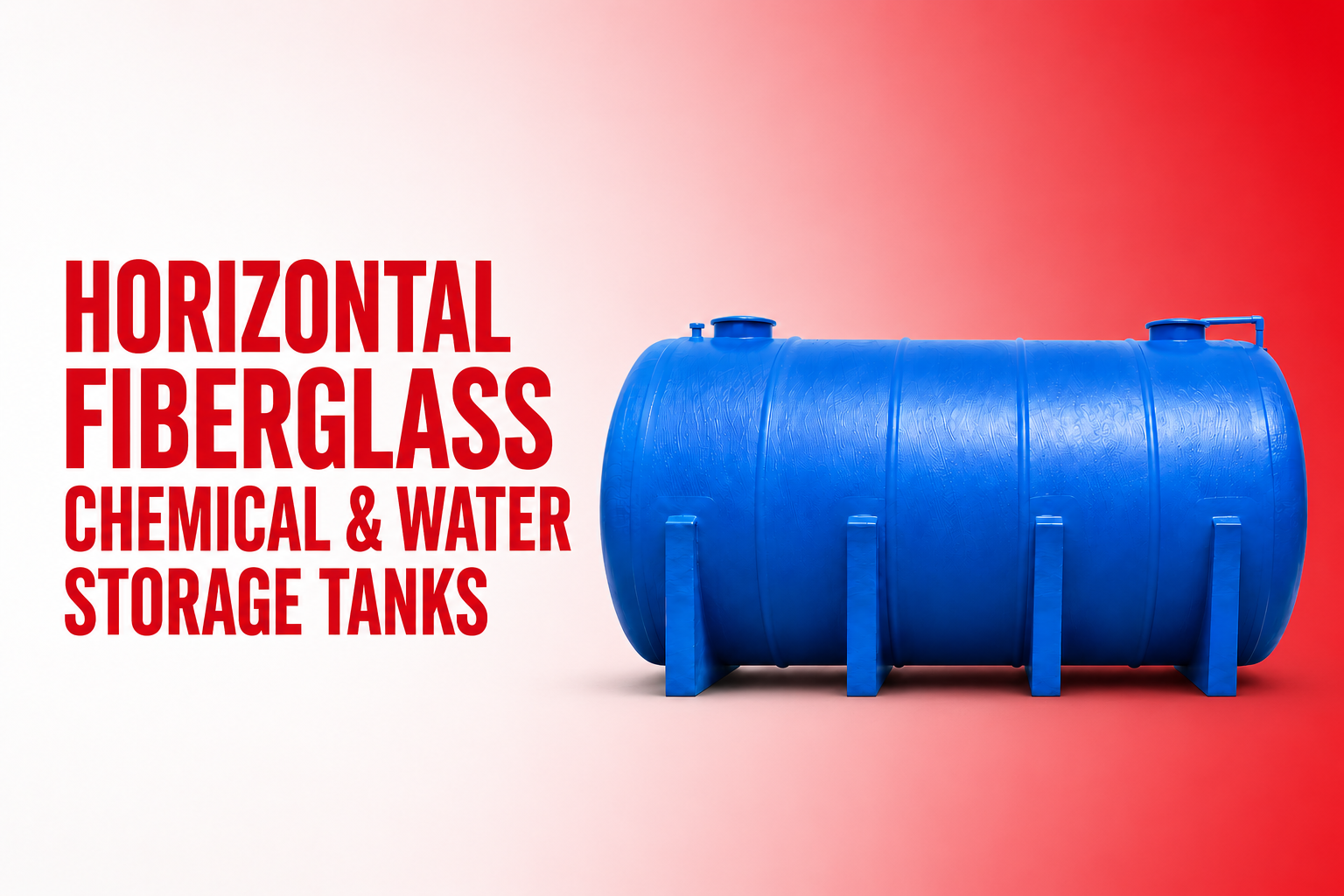
When the plant decided to rebuild, they replaced the failed vessel with a Horizontal Fiberglass Chemical & Water Storage Tank engineered by GRP Engineers.
Industrial sites rarely have ideal conditions. Low ceiling clearances, tight overhead piping racks, high wind zones, and strict seismic load restrictions often make tall vertical vessels impractical.
While a vertical vessel concentrates massive hydrostatic pressure onto a small footprint, a horizontal cylindrical vessel distributes hydraulic weight over an extended horizontal axis. This geometry provides exceptional stability and lower overall height. However, handling aggressive industrial acids or pure demineralized water in horizontal geometry requires advanced structural composite engineering.
A standard plastic or polyethylene tank degrades under continuous ultraviolet radiation and lacks structural rigidity over large volumes. Stainless steel, while rigid, remains susceptible to chloride stress cracking and pitting from aggressive acids.
The engineered solution lies in advanced Fiber-Reinforced Polymer (FRP/GRP) composite technology from GRP Engineers' Fiberglass Division.
Air Handling Performance & Material Matrix
|
Parameter |
Engineering Standard / Specification |
|---|---|
|
Material Construction |
High-Grade Fiber Reinforced Polymer (FRP / GRP) |
|
Manufacturing Standards |
ASTM D3299, ASTM D4097, BS 4994, ASME RTP-1 |
|
Available Capacities |
500 Liters to 100,000+ Liters (Custom Engineered) |
|
Operating Temperatures |
-40°C to +120°C (Application Dependent) |
|
Mounting & Orientation |
Horizontal Cylindrical Shell on FRP / Coated Steel Saddles |
|
Corrosion Barrier |
2.5 mm to 5.0 mm Resin-Rich Liner with C-Glass Veil |
|
Exterior Protection |
UV-Inhibited, Weather-Resistant Gel Coat |
Material Corrosion Resistance Weight Maintenance Design Lifespan
FRP / GRP ★★★★★ (Inert/Custom) Lightweight Negligible 30+ Years
Stainless Steel ★★★☆☆ (Pitting Risk) Heavy Moderate 10–15 Years
Lined Carbon Steel ★☆☆☆☆ (Liner Delam) Very Heavy High 5–10 Years
HDPE / Poly ★★★☆☆ (UV Brittle) Lightweight Low 7–12 Years
Every horizontal storage vessel fabricated by GRP Engineers is built through precision filament winding and multi-layer contact molding. Each layer serves a critical functional role:
[ Inner Chemical Liner ] ---> [ Intermediate Core ] ---> [ Structural Winding ] ---> [ Outer UV Shield ]
(High-Resin C-Glass) (Anti-Corrosion Mat) (Filament Wound E-Glass) (Weatherproof Topcoat)
- The Chemical Barrier (Inner Liner): A resin-rich layer (90% resin, 10% chemical-grade C-veil or synthetic veil). It forms a non-porous seal that prevents chemical migration into the load-bearing laminates.
- The Intermediate Anti-Corrosion Layer: Reinforced with chopped strand matting (CSM) saturated in flexible resin. This zone absorbs dynamic hydraulic shocks and thermal cycling.
- The Structural Load-Bearing Wall: Continuous, high-tensile E-glass rovings wound at optimized helical angles to withstand hydrostatic loads, internal vacuum, and structural bending moments across support saddles.
- The Exterior Weather Shield: A UV-stabilized, fire-retardant gel coat that withstands outdoor weathering, intense solar radiation, and industrial atmospheric acid mist without requiring repainting.
A storage tank does not operate in isolation—it is the central hub of an active liquid handling network.
GRP Engineers integrates storage vessels directly with other specialized fluid systems:
- For vertical process layouts with deep foundations, compare with Vertical Fiberglass Chemical & Water Storage Tanks.
- For active mixing, temperature-controlled blending, or exothermic processes, pair with Fiberglass Process & Reaction Vessels.
- For transferring corrosive fluids into and out of storage without leaks, integrate with high-performance Industrial Chemical Pumps from the Machinery Division.
- For structural metal repair and cold-weld maintenance around the plant, utilize Diamant Polymer Systems.
Learn more about decades of composite innovation on the GRP Engineers History Page.
- Chemical Manufacturing & Processing: Bulk containment of hydrochloric acid (HCl), sulfuric acid ($H_2SO_4$), sodium hydroxide (caustic soda), and liquid chlorine compounds.
- Textile & Processing Mills: Storage of bleaching agents, acetic acid, scouring solutions, and dye auxiliaries.
- Water & Wastewater Treatment Plants (WTP / ETP): Storage of alum, coagulants, sodium hypochlorite, and treated effluent holding.
- Power Plants & Heavy Manufacturing: High-purity demineralized (DM) water storage, condensate collection, and cooling tower makeup water.
- Food & Beverage: FDA-compliant potable water storage and CIP chemical holding.
What is the expected service life of a horizontal fiberglass storage tank?
When engineered specifically for the stored fluid and operational temperature, an FRP/GRP horizontal tank provides an operational service life of 25 to 35+ years with minimal maintenance.
Why choose horizontal over vertical storage tanks?
Horizontal tanks provide a lower center of gravity, making them well suited for indoor facilities with low ceiling clearances, areas with high seismic or wind activity, and installations requiring broad, uniform foundation load distribution.
How are horizontal fiberglass tanks mounted?
Horizontal vessels are supported by custom-engineered FRP or epoxy-coated steel saddles. Heavy-duty elastomeric wear pads are fitted between the vessel shell and saddle supports to eliminate localized mechanical stress.
Can these tanks be used for underground storage?
Yes. GRP Engineers manufactures underground-rated horizontal tanks equipped with external structural stiffening ribs designed to withstand soil backfill pressure, vehicle traffic loads, and groundwater hydrostatic uplift.
Upgrade your facility's safety and operational reliability with corrosion-proof composite containment. Contact the technical team at GRP Engineers & Consultants to discuss custom capacities, chemical compatibilities, and nozzle configurations.
- Office: 88-T, 1st Floor, Commercial Area, Phase 2 DHA, Lahore, Pakistan
- Phone: +92 42-35707737-38
- Email: sale@grpengineers.com
- Explore Products: GRP Engineers Product Catalog